
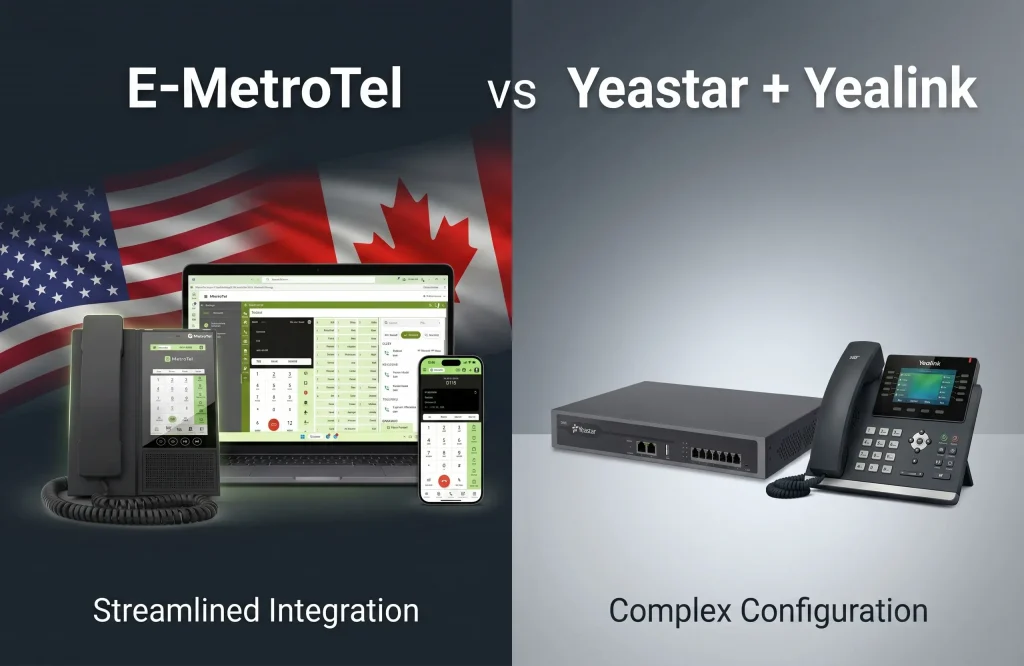
When businesses compare E-MetroTel vs Yeastar + Yealink, they are usually looking for a business communication system that is reliable, secure, flexible, and easy to manage. While Yeastar + Yealink can create a workable communications setup, it often becomes a multi-vendor solution that requires more integration, more oversight, and more ongoing management.
E-MetroTel, proudly a U.S.-based company, offers a fully integrated, enterprise-grade business communication platform designed for simplicity, performance, security, and long-term value. For organizations that want a complete solution instead of managing multiple vendors, E-MetroTel stands out as a strong alternative.
Complete Platform vs. Assembled Solution
One of the biggest differences between E-MetroTel and Yeastar + Yealink is how the solution is built.
With Yeastar + Yealink, businesses often end up with an assembled ecosystem:
- Yeastar provides the PBX
- Yealink provides the endpoints
- SIP provider is separate
- Integration and compatibility must be managed by the customer or IT team
This means the solution depends on interoperability between multiple vendors.
With E-MetroTel, the communication system is fully integrated from the start. The platform includes:
- UCX platform (PBX)
- Phones
- Softphones
- SIP trunks
- Applications
Everything is engineered to work together smoothly out of the box.
Yeastar + Yealink is often an integration project.
E-MetroTel is a turnkey business communication system.
U.S Based Enterprise Solution vs. Overseas SMB Focus
Another important factor in the E-MetroTel vs Yeastar + Yealink comparison is the target market and deployment strength.
E-MetroTel:
E-MetroTel is a U.S.-based company and its solutions are built for:
- Multi-site enterprises
- Government organizations
- Healthcare environments
- Large-scale deployments
E-MetroTel also supports hybrid architecture, including cloud + on-premise failover, which helps organizations maintain communication even when internet service is interrupted.
Yeastar + Yealink:
Yeastar and Yealink are China-based vendors that are often focused more heavily on the SMB market. Their solutions are generally known for cost-effectiveness and simplicity, but they may not offer the same level of enterprise resilience and deployment flexibility.
For larger organizations or those with mission-critical communication needs, this difference matters.
Infrastructure Flexibility Is a Major Advantage
Infrastructure flexibility is one of the strongest reasons many organizations choose E-MetroTel over Yeastar + Yealink.
Yeastar + Yealink:
This solution is mainly IP-based, which means:
- Ethernet is required
- Full network readiness is needed
- Older infrastructure may need replacement
E-MetroTel:
E-MetroTel supports multiple environments, including:
- Digital phones using single-pair wiring
- Analog
- IP
This makes it possible for businesses to take a green migration approach by reusing existing infrastructure instead of replacing everything at once.
This is especially valuable for:
- Hospitals
- Warehouses
- Campuses
- Older commercial buildings
For organizations with legacy systems, E-MetroTel offers much more flexibility during migration.
Flexible Cost Model vs. Subscription Dependency
Cost structure is another key difference.
Yeastar + Yealink:
Businesses may need to manage:
- Subscription fees
- Licensing tiers
- Paid add-ons
E-MetroTel:
E-MetroTel offers:
- Perpetual licensing options
- No forced subscription model
This gives businesses better control over long-term spending and improves overall return on investment.
For companies focused on predictable budgeting and lower lifetime costs, this can be a major advantage.
Security, Control, and Accountability
Security is not just about having features. It is also about reducing complexity.
Yeastar + Yealink:
This setup is usually based on a standard SIP deployment, and security often depends heavily on how well the IT team configures and manages the environment. Because the solution involves multiple vendors, there can be more room for misconfiguration and operational risk.
E-MetroTel:
E-MetroTel provides a more controlled ecosystem with reduced cloud dependency and a more predictable operating environment. This can help reduce exposure to:
- Misconfigurations
- SIP attacks
- Multi-vendor complexity issues
For businesses that value security, stability, and accountability, this is an important benefit.
Migration Advantages and Cost Savings
For organizations replacing older phone systems, migration costs can have a major impact on the final decision.
Yeastar + Yealink:
In many cases, migration may require:
- New phones
- New cabling
- User retraining
E-MetroTel:
E-MetroTel can help businesses reuse:
- Existing wiring
- Legacy digital phones, including systems such as Nortel
This can lead to 30 to 40 percent or more in migration cost savings, depending on the environment.
That makes E-MetroTel especially attractive for businesses that want to modernize without replacing their entire communications infrastructure.
Built-In Enterprise Features Instead of Add-Ons
Feature depth also matters when comparing communication platforms.
Yeastar + Yealink:
This combination offers a solid feature set for SMB needs, but advanced functionality may require extra integrations or add-ons.
E-MetroTel:
E-MetroTel includes enterprise-focused capabilities as part of the core platform, such as:
- Contact center
- Mobility
- Messaging
- Hybrid failover
- Advanced routing
Instead of building around separate tools, businesses get these capabilities within a single unified communications platform.
Who Should Choose E-MetroTel?
E-MetroTel is often a better fit for organizations that need:
- A fully integrated business communication solution
- Enterprise-grade reliability
- Hybrid failover capability
- Support for digital, analog, and IP environments
- Lower migration costs
- Better long-term control over licensing and infrastructure
It is especially well suited for enterprises, healthcare organizations, multi-site businesses, campuses, and facilities with existing legacy wiring.
Who Might Prefer Yeastar + Yealink?
Yeastar + Yealink may still be a reasonable option for:
- Small businesses
- Organizations with simple IP-only environments
- Teams comfortable managing multiple vendors
- Businesses looking for a flexible and lower-cost DIY-style deployment
This setup can work well when enterprise resilience and infrastructure reuse are not major priorities.
Final Takeaway
Yeastar + Yealink is a toolkit built from multiple vendors.
E-MetroTel is a complete, U.S.-based business communication system.
For businesses that want stronger reliability, easier management, better migration flexibility, and enterprise-grade performance, E-MetroTel offers a more complete solution.