

Imagine this. You run a busy office with sixty desk phones. They are good phones. Your team knows every button, the speed dials are set up just right, and nobody has complained in years. Then your phone system reaches the end of its life, and the quote for a new one arrives. Near the bottom is a line you did not expect: sixty new phones.
Your first thought is probably the same one we hear from business owners every week: why can’t I just keep the phones I already have?
It is a fair question, and the honest answer is not as simple as “they are too old.” In most cases, the phones are fine. The problem is that they were built to speak one system’s language. Let’s look at why that happens, what replacing them really costs, and how you can keep them while still moving to a modern phone system.
Why Business Phones Often Can’t Be Reused
Think of your desk phone and your phone system as two people having a conversation. For years, they have spoken the same language. When you bring in a new system, it may speak a completely different one, and suddenly the conversation stops. Nothing is broken. They just no longer understand each other.
Proprietary phone protocols
That “language” is called a protocol. Many manufacturers use their own private, or proprietary, protocol. A phone designed for one brand’s system usually cannot talk to another brand’s system, even though it still works perfectly.
Digital phones, IP phones and the wiring behind them
There is also the question of how phones connect. Digital phones use traditional phone wiring, while IP phones run on your computer network. If a new system only supports IP phones, a business with digital phones may be told it needs new handsets, new network switches, and sometimes even new cabling.
When “compatible” isn’t the full story
Some systems can connect older phones using an open standard called SIP. That sounds like good news, and sometimes it is. But often the phone only gets basic calling. The programmable buttons your team relies on may stop working, and the phones may need new firmware and reprogramming one by one.
What Replacing Every Phone Really Costs
Back to our office with sixty phones. The handsets are the obvious cost, but they are rarely the biggest one. Someone has to unpack, set up and program every phone. The network may need upgrades to power and connect them. Every employee needs time to learn the new phone, and for the first few weeks, calls get transferred to the wrong person and voicemails get missed.
Then there are the old phones themselves. Sixty working devices end up in a storage room or a recycling bin, adding to the growing problem of electronic waste. For a business with several locations, multiply all of this again.
A Different Approach: Keep the Phones That Work
At E-MetroTel, we believe you should get full value from the phones you already own. Our platforms support many existing digital and IP phones from major manufacturers through XSTIM technology, which lets the new system speak your phones’ language.
For that office with sixty phones, the change is almost invisible to staff. They arrive on Monday, pick up the same phone, press the same buttons, and their calls simply run on a modern, supported system. Here is what that means in practice:
Your budget goes further
Instead of spending on new handsets, you can invest in tools that actually move your business forward, such as mobile apps, a contact center or better customer service features.
Your wiring and network stay as they are
Supported digital phones keep using your existing phone wiring. There is no costly rewiring, and keeping voice on that wiring also keeps it separate from your data network.
Your team keeps working without retraining
People keep the phones they know. That matters most where staff change often, such as retail stores with many part-time employees.
Your system stays supported and secure
The phones may be familiar, but the system behind them receives regular updates and security patches, so you are no longer relying on equipment that nobody supports.
What You Can Add When You Are Ready
Keeping your phones does not mean standing still. Once your system is modernized, you can add new capabilities at your own pace: E911 notification, scheduled announcements, find me, follow me call routing, and hotel property management integrations.
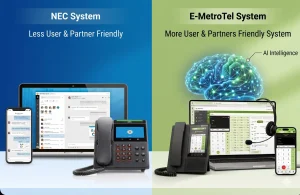
Recent additions to the platform include Microsoft Teams integration, DECT wireless phones, a new analog call box for places like healthcare facilities and warehouses, support for NEC digital and IP phones, and the Infinity 7000 series large touchscreen phones for anyone who wants a new phone.
You also choose where your system runs. Our InfinityCX software works on on-premises appliances, on virtualized servers, or in the cloud, and you can change your mind later as your business grows.
The bottom line
Your phones are rarely the problem. They are replaced because a new system cannot understand them, and that replacement costs far more than the handsets alone. With E-MetroTel, many existing digital and IP phones can stay on your desks while everything behind them is upgraded.
Frequently Asked Questions
Why do I need new phones when I change phone systems?
Many phone systems only work with phones that use the same manufacturer’s protocol. Your phones still work, but the new system cannot communicate with them. E-MetroTel supports many of these phones, so you may not need to replace them.
Can I reuse my old business phones?
Often, yes. Many NEC, Avaya, Nortel and Panasonic digital and IP phones can work with E-MetroTel platforms. Our team can confirm your models.
What is a proprietary phone system?
It is a phone system that uses a manufacturer’s own private protocol between the phones and the system, so its phones are designed to work fully only with that manufacturer’s equipment.
Is it cheaper to keep my existing phones?
Usually. Keeping working phones avoids the cost of new handsets, and it saves the time needed for setup and training.
Do I need new wiring for VoIP?
Not necessarily. With E-MetroTel, supported digital phones can keep using your existing phone wiring while the system behind them is modernized.
Keep Your Phones and Upgrade Everything Else
Before you approve that line for sixty new phones, ask a simple question: do they really need to go? With E-MetroTel, the answer is often no.
Talk to our team about keeping your phones, or email us at [email protected]. We would be happy to look at your phone models and suggest the best plan for your business.